If you’re into electronic music and/or sound design definitely check out this live panel discussion featuring Eric Persing, Diego Stocco, Richard Devine and Scott Gershin.
Category: Gear
Yes, it’s my one year mandoversary — I’ve been playing the mandolin for one year! Well, to be completely accurate it’s been slightly longer than one year, but I didn’t have the time to write this post until today.
A little over a year ago Sonya, my wife, suggested I get a mandolin. She thought it would be a great “challenge” for me. She was right.
To be honest, I wasn’t all that keen on taking up the mandolin. I already had a lot on my plate with guitar, composition, production, engineering and the wall of business stuff I have to do each day. Yes I loved the sound of the instrument, but I wasn’t sure I wanted to make the time investment into the mando (BTW, that’s the short form for the mandolin). So I decided I would first rent a mando from a local music store. The instrument was, to be kind, horrible. Think of a cardboard box with old dead strings on it. That would have sounded better than the rented mando. But something resonated with me and don’t know exactly what it was. I suppose the short answer is I was bitten by the mando bug.
So I made the leap and bought a fairly nice instrument — an Eastman MD515. Here’s a picture of me on the day I brought the mando home:
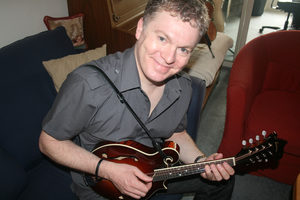
And then I started down, what has been (and will continue to be) a very long path of trying to learn the mandolin. It’s a great path to be on — man I love the mando!
For those of you thinking to pick up the mandolin or add it as a second (or third or fourth) instrument, here’s what I’ve learned over the last year:
Time Matters
There really is no substitute for time. You really do have to practice. And practice a lot. My teachers all told me that consistent, sustained practice was the key to progressing on an instrument. And they were right.
I have a certain amount of facility on the guitar and I think that made me think that picking up the mando would be easier than it has been. I feel like my playing has leapt up on the mando over the last few months, but it was definitely frustrating in the beginning. The fact that I play every day for at least an hour has, in my mind, been the most important factor in my progress.
Practice Right
Of course, there’s no one way to learn an instrument, but for me, taking a traditional approach to learning has worked very well. I work on scales, chords and sight reading in addition to learning pieces by Bach, traditional Celtic tunes and improv every day.
Get A Good Instrument and Have It Set Up Properly
The subheading pretty much says it all. A good mandolin, set up nicely plays like butter. To me, it seems like a good set up is more critical on the mando than on the guitar.
Pick The Right Pick
The type of pick you choose to play on the mando is extremely critical. The material and shape of the pick will have a profound affect on the tone you produce. I went through a whole bunch of different picks and found that the Blue Chip TP-1R 40 works best for me.
Well that’s about it! I’m sure I’ve learned more than I’ve written in this post, but I have to get back to practicing!
Chris Thile: Tips on how to crossover from guitar to mandolin
I’ve just started learning the mandolin and came across this great Chris Thile video on crossing over from guitar to mandolin. I think Chris is exactly right about the challenges guitarists face when making the shift from guitar to mandolin. The string spacing is definitely a challenge, but I’m finding the biggest obstacle is the tuning. Going from standard tuning on the guitar to the mandolin’s fifths based tuning is a real brain/finger tester! Still I’m absolutely loving playing the mandolin and I’m sure the instrument is going to end up on some future recording and on stage.
My New Mandolin!
Here’s a shot of me with my new mandolin! It’s an Eastman MD515 and it sounds absolutely fantastic!

Namba Gear
Thanks to Namba Gear for making me a featured artist on their website!
SR Technology JAM 150 Plus
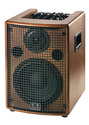 I have a keeper! I just picked up an SR Technology JAM 150 Plus and it’s exactly what I was looking for: An amp that is more than an amp. I play a fairly wide range of sounds — everything from nylon string guitar to electric to guitar synth — so I need an amp that can handle a huge frequency range and lots of dynamics. The JAM 150 Plus does that with ease.
SR Technology has made the JAM 150 Plus incredibly simple to operate. You basically have six input channels. Channels 1 and 2 have 1/4″ inputs as well as XLR inputs, channel 3/4 has 1/4″ inputs that can be used either separately or in combination, channel 5/6 has RCA inputs designed to take an input from your iPod, computer or CD player. Channels 1, 2 and 3/4 have a high, mid and low eq and an effects send (works on both the internal effects or the effects send). Channel 5/6 has a high and low eq. You also have RCA record outs with a level knob, an XLR line out, a 1/4″ effects send and two effects return inputs.
SR Technology has included some built in digital effects. You have a choice of four effects — one delay and three reverbs. As well, there’s a phantom power switch for condenser mics and there’s a handy ground lift on the back of the amp. One last point, the Jam 150 Plus has a mount on the bottom of the speaker which would make it perfect for use as a main PA speaker. Honestly, if you’re at all familiar with running a small mixer you’ll have zero trouble with the JAM 150 Plus.
So how does it sound? That’s really the most important thing. Well, it sounds amazing! Big and open with a huge amount of headroom. Everything I’ve put through the amp has sounded absolutely first rate. Running my main guitar, a Godin Multiac Grand Concert SA through my pedalboard, then into Mainstage 2 (for reverbs and delays) and finally out to the JAM 150 Plus produced some of the best tones I’ve ever had. When I added synth sounds to my nylon string, I was able to create tones that were lushand defined.
And while we’re on the subject of synth sounds… SR Technology states that the amp’s frequencies extend down to 40 Hz (and all the way up to 20 kHz). I have no way to accurately measure this, but I did test out the bottom end on the amp. I dialed up a monstrously low synth bass using Spectrasonics Trilian. The walls of my condo shook! Seriously. This amp has no shortage of bottom end, so if you’re a guitarist using any kind of detuning, the JAM 150 Plus is not going to let you down.
On the electric guitar side of things, the JAM 150 Plus brought my tones to life. All of my electric sounds (amps and effects) come from Mainstage. I still occasionally use Amplitube 2 (great plugin!), but the new Amp Designer and Pedalboard plugins in Logic/Mainstage are my number one choice for electric sounds. Playing these electric sounds through the JAM 150 Plus was an absolute joy! It feels great and that makes me play better. To be clear, the JAM 150 Plus doesn’t offer any kind of built in amp modeling — you’re going to need your amp models and effects to be generated by a plugin, effects pedal(s) or some combination of the two.
I guess by now you can tell I’m a fan of this amp. The SR Technology JAM 150 Plus has everything I look for in an amp: top notch sound quality, portability (the amp weighs only 29 lbs) and world class build. Doesn’t hurt that it looks pretty sharp too! I’m keeping it!
My New Acoustic Pedalboard
Here’s a shot of my new acoustic pedalboard:
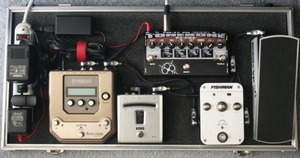
I’m loving the sound of this pedalboard! The Tonebone PZ-Pre put the the final touch on the overall sound quality, but I think the Fishman Aura (Nylon String) and the Yamaha Magicstomp Acoustic are equally important to the tones I’m getting now. And I have zero complaints about the Ernie Ball VP Jr. or the Korg DT-10 tuner. Everything is working perfectly!
Making Stringed Instruments in China
An interesting “behind the scenes” look at the making of stringed instruments in China.
Guitar market strikes a nostalgic chord
Guitar market strikes a nostalgic chord
Even with prices slightly dropping, it looks like guitars are solid investment. “A Gibson Les Paul Standard that sold in 1958 for less than $300, including the guitar case, can now fetch $420,000 or more — an average annual gain of 32% since 2000, according to vintage guitar price guides.” Not a bad return I’d say. Hey, can anyone spare half a million so I can pick up a couple used guitars?
Meet My Little Friend
Actually, meet my two little friends — the Mackie SRM150‘s. Without a doubt these are some of the best pieces of gear I’ve purchased in a long time.
So what exactly is the Mackie SRM150? Well, it’s a lot of things. Mackie calls it a Compact Active PA System — an apt, but fairly broad and non-committal description. It can be used as a PA, but it has so many other uses. With a three channel mixer, three band eq, phantom power, an audio “thru” with a mic/line switch, 150 watts of power and the ability to mount the speaker on a mic stand, I think you get a sense of the sonic possibilities that the SRM150 presents. For the past year I’ve used the SRM150’s as my stereo guitar amp. I come straight out of my pedal board into the SRM150’s — best sound I’ve ever had. My Line 6 POD 2.0 sounds amazing through this set up too.
I have a few minor quibbles. First, getting the decent bass response that SRM150 has I’m sure wasn’t an easy job. However, a combination of very low bass frequencies and high volume cause the mic/line button on the back of the speaker to vibrate and produce an audible noise. This happens on both the SRM150’s I have. Basically, I’m guessing Mackie had to find a way to port the speaker and the mic/line button and the XLR thru were their answer. In day to day use this buzzing/noise is an absolute non-issue for me (I never play that loud), but still, I think Mackie could have found a better solution to the problem.
My second quibble is that I would have preferred that the SRM150’s had mounts for speaker stands and not, as they currently do, for mic stands. I get where Mackie is coming from — a performer comes into a club and is able to easily mount their SRM150 on one of the clubs mic stands. But from my point of view, putting 7 + pounds of gear up on a mic stand is just asking for trouble. I can’t even begin to count the number of mic stands I’ve seen knocked over. I’m sure there are (or will be made available) connector/adaptors to allow the SRM150 to mount on speaker stands, but still my vote would be to have the speaker stand mounts built into the speaker.
So what do I like best about the SRM150’s? The sound, the weight (7.6 lbs), the size (it’s smaller than a bread box!) and the flexibility (it’s a PA, it’s a guitar amp, it’s a monitor…). This one’s a winner!
 Jamie Bonk