Studio Gear Update – Part 1

Every now and then I take a look at my studio gear and try to figure out better ways to use everything.  Mostly my studio is ITB (in the box), meaning it’s pretty much all computer-based.  Other than my guitars, a few pedals, some mics, an audio interface, speakers, and headphones, everything is zeroes and ones and lives inside my Mac Studio.  I’ll do a couple of future posts on my guitars, pedals, and other gear, and in this post, concentrate on the computer side of things.

I’m still a Logic Pro guy and probably always will be.  At this point, it feels like home and by and large does what I’d like it to do.  All of the editing (MIDI and audio) is great, terrific automation, creating lead sheets and notating parts is a breeze, and the plugins are first-rate.  The overall performance of Logic on my Mac Studio (M1 Max) is incredible, so in terms of computing power, for what I do, I don’t need any more horsepower than I already have.

If you’re just starting out, I think you can do great work with just the stock Logic plugins.  Even with all of the third-party plugins I have, I still use many of Logic’s stock plugins — the Session Player(s) sounds and loops are great, Alchemy is first-class, the reverbs get a lot of use, and the Gain plugin, as simple as it is, is always handy.  That said, I have lots of third-party plugins that are my first choice.  I keep thinking one day I’ll do a whole track using third-party plugins and then redo the track using stock plugins as a comparison.  My guess is it would sound pretty darn close, but it would be nice to actually do the “experiment”.  So here are my go-to, third-party plugins (in no particular order) broken down by category:

MIDI

  • Spectrasonics Omnisphere — Reach for this one on everything I do.
  • Spectrasonics Trilian — For the times when I don’t have a live bass player.
  • Spectrasonics Stylus RMX — An oldie but a goodie.  This plugin needs an update, but it’s still incredibly useful.
  • Toontrack EZDrummer 3 — Fantastic sounds, great drum part editor, and terrific grooves.
  • Plugin Guru Unify — This plugin is slowly moving its way up the ladder.  I’m more familiar with Omnisphere, but Unify really does live up to its name — pulls together all of my plugins and more.  Looking forward to their new release with multi-outs.
  • Spitfire Audio Originals – Intimate Strings — Gorgeous textures and blends well with other string libraries.
  • Spitfire Audio BBC Symphony Orchestra — I have the free version, and it sounds terrific.  This is another library that layers/blends well with other orchestral plugins/samples.
  • Modartt Pianoteq 4 Stage – I need to update this guy, but if I need a piano sound, this is the one I reach for.
  • Kirk Hunter Symphony Orchestra Emerald — This is an older sample library that I still use all the time blended with other libraries/plugins.

AUDIO

  • Brainworx bx_console SSL 9000 J— I have a few console-type plugins that all have their strengths.  The SSL 9000 J is the one console that I keep coming back to and use it on just about every track in every project.
  • SPL Iron — Great compressor.  If I had to choose just one compressor, this would be it.
  • SPL PQ — This EQ works the way I hear.  I have no idea why it sounds better than most of my other EQs — it just does.
  • AMEK Mastering Compressor — A top-shelf compressor that I primarily use on my mix bus, but it sounds terrific on just about anything.
  • Brainworx bx_limiter True Peak – I’ve been using this as my final limiter for the last few years.  This limiter sounds fantastic on just about everything, so I don’t know if I’ll ever need another one.
  • Black Box Analog Design HG-2MS — One of the best saturators out there.  For me, a little goes a long way.
  • ADPTR MetricAB — A beyond useful plugin.  It does all kinds of monitoring from LUFS to stereo info and it lets you easily compare your track to other releases.
  • iZotope Ozone 11 — I was trying to remember when I first picked up Ozone — probably 15-20 years ago.  I’m sure I could do mastering without it, but it wouldn’t be as easy or sound as good.
  • iZotope Tonal Balance Control 2 — Great for a quick check of the frequencies in your mix/master.  I find it particularly helpful for bass/kick levels in my mixes.
  • PSP Xenon — One of the best limiters I’ve heard.  Set up correctly in “C” mode and not pushed too hard, this limiter is amazingly transparent.

So that’s a quick look at my current favorite plugins.  I’m sure in six months the list will have some new names on it, but this is where I am in Spring 2025.  I’m always interested in trying out new things, so I’d love to hear what your go-to plugins are!

“Rain” (Live in the Studio)

From my second album, “A Perfect Tomorrow”, here’s a live in the studio version of “Rain”.  I’ve played this tune on gigs for 20 years or so now and I’m still finding new things to add to it.  All of the outdoor/non-studio shots are from right around here — either by the Inlet (Port Moody) or Barnet Marine Park (Burnaby). 

Neumann NDH 20 Headphones

Studio Shot with Neumann NDH 20 Headphones (November 2020)

Very occasionally a product works pretty much exactly how I would like it to. Checks all of the want/need boxes and actually goes beyond what I was hoping for. The Neumann NDH 20 Headphones that I picked up a little while ago are just about perfect for what I do (whether that’s writing, recording or engineering).

First off, the NDH 20’s are extremely comfortable, so I’m able to wear them for long periods of time. If headphones are uncomfortable in any way I just can’t use them — simply can’t concentrate on the music I’m working on. The build quality is also incredible. They feel rock solid and substantial. My guess is unless you are really hard on gear (I’m not), these headphones will last for a long, long time.

The NDH 20’s are closed back headphones, which is important for me. My studio is by a somewhat noisy road and the NDH 20’s cut out quite a bit of the stuff I don’t want to hear. This isn’t to say the headphones completely isolate me from all of the V8 pickups, muscle cars and leaf blowers, but they do help me to better focus on my music.

Obviously, sound quality matters a lot and can be very subjective. Some people want headphones (and/or speakers) to give them a hyped vibe (i.e. boatloads of low end, sizzling high end, etc.). I’m the opposite — I want whatever system I’m listening to to be as neutral as possible. This is where the NDH 20’s really shine. I have an Apogee Element 24 and when using the Neumann’s with that interface, the sound is very flat and remarkably clear. The headphones are also loud — they have way more output than I need.

So what’s not to like? Well… I don’t like the sound of the cable rubbing against my shirt. Neumann used a texturally rough cable and you can definitely hear the cable when it touches your clothes. The sound transfers inside the headphones. Also, they flipped the cable output — put the cable out on the right headphone instead of the left. Not a big deal and it actually works better for my setup, but still it’s different than I’m used to.

Would I recommend these headphones to someone? Maybe. Really depends on what you’re looking for. If you’re primarily a casual listener, then I’m not sure these guys are for you. I find the NDH 20’s to be very revealing — I hear details in music I’ve listened to forever that I never noticed before. Personally, when I’m listening to music for enjoyment, I can find it distracting to suddenly be aware of amp hiss, weird edit points, etc. On the other hand, if you’re working on the creative/production side of the equation, the Neumann NDH 20’s are an amazing tool and I’m happy I have the opportunity to use them.

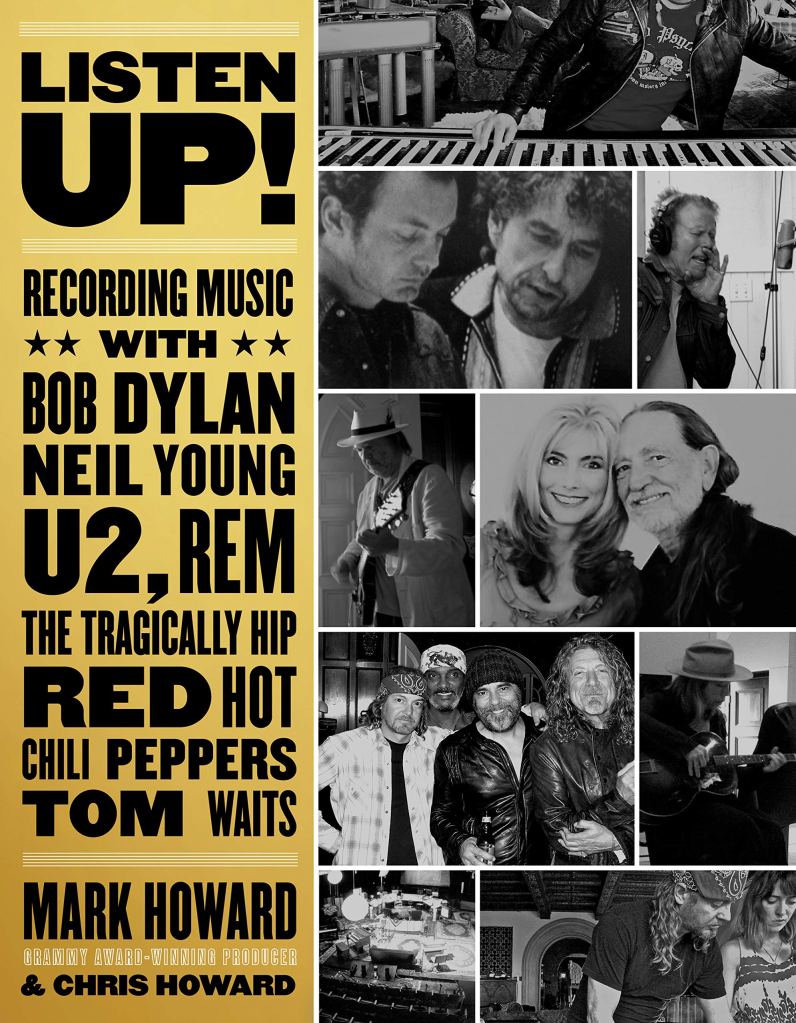
“Listen Up!” by Mark and Chris Howard

I’ve read quite a few music related books. Some books were for school (i.e. the history of a particular period in time or on orchestration) and some books were more for enjoyment. “Listen Up!” by producer/engineer Mark Howard and his brother Chris is somewhere in the middle of those two extremes. The writers found a nice balance between the industry/gear talk and the social/personal aspects described in the book. And wow, there sure is a ton of stuff discussed. “Listen Up!” is like a freight train of activity — one project directly following another project following a tour and then followed by yet another project.

Besides Mark’s own production/engineering projects, he has worked extensively with producer/guitarist/singer/songwriter Daniel Lanois. Lanois’s approach to recording was often installation based — in other words he would set up a studio in a nontraditional setting such as a house. In many cases, it was one of Mark’s roles to “build” the studio. He would scout out a location, get the gear and assemble everything. He also spent a fair amount of time considering the decor of the studio. The feel/vibe of a space can absolutely affect how musicians perform, so it makes sense he thought about things like lighting, rugs and accessories.

A few things jumped out at me while I was reading the book. First was the incredible level of detail. Mark either has a fantastic memory or he kept a journal, but regardless the details help paint a very clear picture of his various interactions. And that was the second thing that caught my attention — all the interactions. It’s no secret that much of the music industry is at least partially based around personal, social interactions. If you work well with one artist then other related artists may want to work with you. The best networking and marketing is good work, which Mark obviously has, but he also has the ability to connect with artists on a personal level.

The third thing I found interesting was the importance of money. Obviously, recording with good gear, an engineer or two and a producer is going to cost at least a few bucks. While I’m aware of albums, like Chinese Democracy, Tusk and Random Access Memories that pushed their related budgets into the extreme, Mark’s recounting of Neil Young’s Le Noise was eye opening. Produced by Lanois and engineered by Mark, they spent six months making the record and when Lanois had the bill for $250,000 handed to Neil Young’s manager, there clearly was a problem. The record label had given Young a budget of $25,000 for the album. Without a doubt, there was a massive disconnect and I’m sure it was a painful lesson for both Lanois and Mark.

If you’re like me and you like to read about artists, the industry and have a look behind the curtain, then Mark and Chris’s writing will absolutely pull you in. “Listen Up!” is a good book and well worth picking up.